Still working on AIMS platform selection? Your Ontario community pharmacy needs a qualifying incident management platform in place by January 1, 2027, but you do not need to choose on marketing claims alone. The Ontario College of Pharmacists (OCP) gives pharmacies the autonomy to select a platform, as long as it meets its published criteria and supports daily anonymous reporting to the National Incident Data Repository for Community Pharmacies (NIDR). OCP does not approve or endorse specific vendors.
On this page
AIMS platform selection: key dates at a glance
-
Now through 2026
Keep recording incidents and near misses
Until your platform is live, record events locally. OCP's optional Medication Event Reporting Form is for internal use only. OCP, January 6, 2026
-
Once you choose a platform
Complete the Data Sharing Agreement online
The Designated Manager creates an account on ISMP Canada's NIDR portal, adds the pharmacy and signs the agreement there. Chains may have one corporate submitter. OCP, October 22, 2026
-
By January 1, 2027 Next deadline
Have a qualifying platform in place
Implement a qualifying reporting platform, create individual logins for registered staff at their primary place of practice, and ensure pharmacy staff complete OCP's AIMS e-Learning modules. OCP Designated Manager checklist
-
Every day from then on
Anonymous uploads to the NIDR
Your platform uploads incident and near-miss data to ISMP Canada daily. OCP platform criteria
-
By April 1, 2027
Hold your first CQI meeting
Then meet at least once every quarter. OCP Designated Manager checklist
-
At least every two years
Complete a safety self-assessment
A validated tool: the ISMP Canada MSSA or the Think Research (Pharmapod) PSSA. OCP platform criteria
OCP’s October 22, 2026 update and platform criteria are the starting point. This checklist is designed for a pharmacy owner or Designated Manager making a decision now. It is more focused on procurement and onboarding than our broader Ontario AIMS requirements guide and January 2027 timeline.
AIMS platform selection: Start with the OCP non-negotiables
Use OCP’s AIMS Incident Management Platform Criteria as your decision document. According to the current criteria, the platform needs to support three core functions: documenting and analyzing incidents and near misses, recording related action plans, and daily anonymous NIDR uploads. A simple web form, on its own, is not enough evidence that all three work.
Ask a vendor to demonstrate both event types
Ask for a realistic incident example and a realistic near miss. In the near-miss demonstration, confirm that the record can capture the required data without asking for a degree of patient harm, which OCP excludes for intercepted events. For an incident, confirm how the 15 mandatory fields are captured, including medication, event type, stages involved, contributing factors and corrective actions. The complete field list is in the OCP criteria.
Also ask how an event moves from the initial report to review, analysis and action tracking. A dashboard showing attractive charts is helpful, but the pharmacy must still be able to document the steps it has taken to reduce recurrence.
Understand the difference between local and shared data
OCP says some mandatory incident fields need to be retained within the pharmacy’s platform even though they are not currently shared with ISMP Canada. That means your system has to keep adequate internal records and transmit only the appropriate anonymous information externally. Ask the vendor to explain this separation, with specific reference to its privacy safeguards and data-sharing workflow.
AIMS platform selection: Verify NIDR readiness, not just a logo
ISMP Canada operates the NIDR. Its official NIDR page explains that data submission involves a pharmacy Data Sharing Agreement, the provider’s Data Submission Protocol Agreement, and successful testing of the provider’s application programming interface or database process. Those are separate steps. A vendor saying it is “NIDR compatible” is not the same thing as the pharmacy completing its own onboarding obligations.
Five questions that reveal the actual workflow
- Has this exact provider completed the necessary technical testing, and can it describe its current agreement status?
- How are daily anonymous uploads initiated and monitored?
- What happens if a required field is missing or a record is rejected?
- How can a pharmacy confirm what has been sent and address errors or outages?
- If we change providers later, how do we retain historical data and update our agreement?
OCP publishes a list of providers that have completed testing and have an agreement in place. It says it does not endorse or approve any platform.
Your pharmacy still signs the agreement
After selecting a provider, the Designated Manager must complete the ISMP Canada Data Sharing Agreement using the NIDR portal instructions. A corporate group may have a designated submitter, so check internal instructions before submitting separately. The portal guide also describes updating an agreement after changing reporting providers. Buying software is not a substitute for this step.
AIMS platform selection: Assess staff access, privacy and workflow
From January 1, 2027, registered pharmacists and pharmacy technicians must have individual platform logins at their primary place of practice. For the professional reporting responsibilities behind this access rule, see AIMS reporting for pharmacy technicians. Relief and occasional professionals are exempt from that specific login requirement. A Designated Manager may grant access to other staff. The OCP checklist sets out the rule.
Ask to see account creation, password resets and user deactivation. Clarify which team members can create reports, edit details, review actions and access sensitive information. A provider should be able to explain how it separates identifiable internal records from anonymous NIDR transmissions and how the pharmacy can control access. OCP places responsibility for privacy and security on the pharmacy, even when a third-party platform is used.
Test the workflow with your actual staffing pattern
A single-pharmacist store and a busy multi-person pharmacy may use different internal review procedures. Run the demonstration with the people who will report most often, including registered technicians. Try a near miss during a typical dispensing process and see whether staff can complete it with the information they actually have, without losing the report.
Consider what happens when the person who discovers an event is not the person who reviews it, or when the Designated Manager is away. Those are sensible implementation tests; they are not extra technical requirements published by OCP.
AIMS platform selection: Check CQI and safety self-assessments
The updated supplemental Standard of Practice requires learning from reports, including analysis of causes, documenting improvements and sharing learnings. OCP’s Designated Manager checklist says the first quarterly CQI meeting must occur by April 1, 2027. It also requires a validated safety self-assessment (SSA) at least every two years. Official checklist.
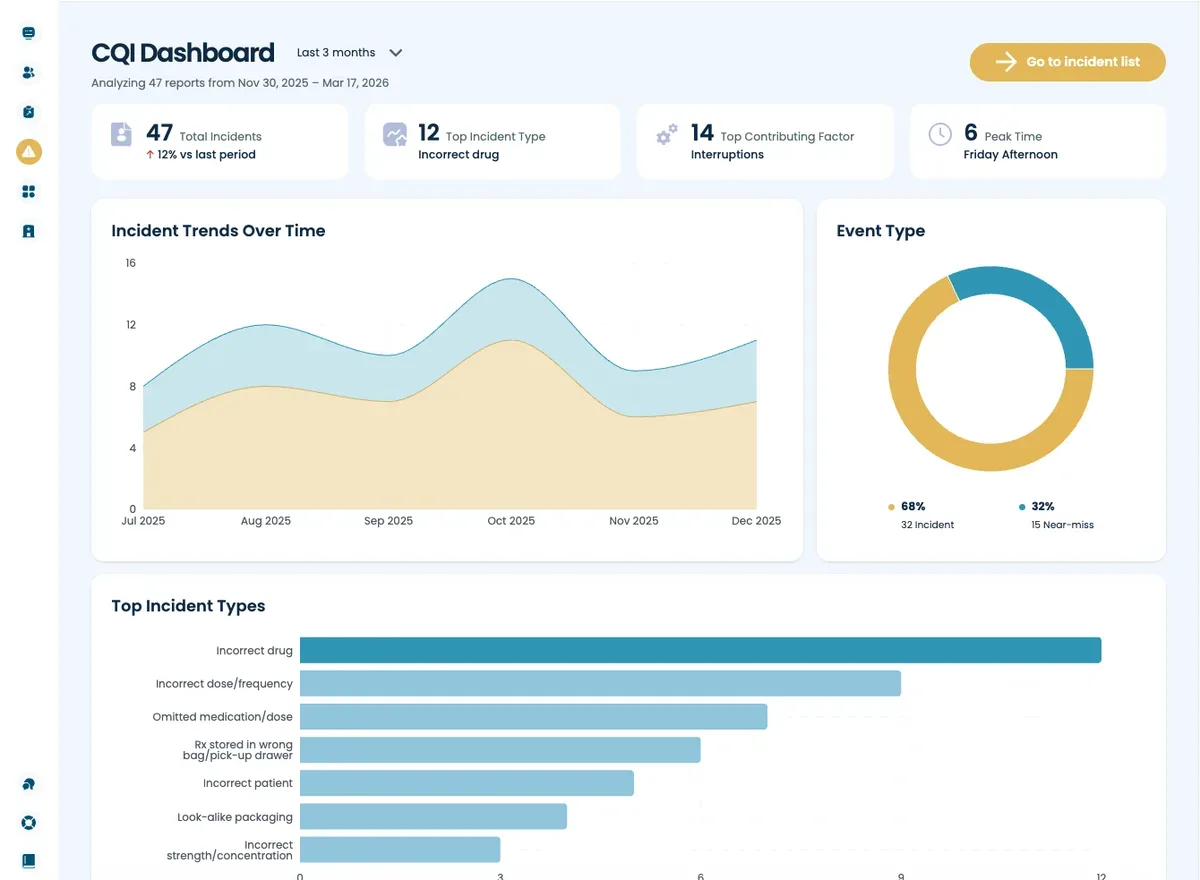
Ask whether your vendor provides meeting agendas, incident trends, action ownership and the ability to track whether changes were implemented. OCP does not require a particular dashboard aesthetic. The question is whether the tool helps the pharmacy perform and document its ongoing safety work.
Do not overlook the validated SSA
OCP names the ISMP Canada Medication Safety Self-Assessment (MSSA) and Think Research/Pharmapod Pharmacy Safety Self-Assessment (PSSA) as nationally available, accepted tools. If your platform does not include a validated SSA, you need to subscribe to one separately. Ask the vendor which tool is included and what limits apply. This matters for compliance and for your total annual cost.
AIMS platform selection: A seven-step implementation plan
Use this plan together with the College’s checklist, not as a replacement for it.
- This week: Read the latest OCP criteria, assign an implementation lead and shortlist providers.
- During demonstrations: Test an incident, a near miss, the 15 required data fields and action-plan tracking.
- Before purchase: Obtain written answers on daily NIDR submissions, user access, SSA inclusion, privacy, support, pricing and termination.
- After selection: Complete the appropriate pharmacy Data Sharing Agreement through ISMP Canada’s process.
- By January 1, 2027: Activate the platform and individual accounts for registered staff whose primary practice is the pharmacy.
- By January 1, 2027: Ensure pharmacy staff complete OCP’s five AIMS e-Learning modules and are trained on your platform.
- After launch: Schedule the first CQI meeting by April 1, 2027 and maintain your SSA schedule.
Do not stop recording events while shopping. OCP’s 2026 transition article says pharmacies without a reporting platform must continue recording incidents and near misses locally and working through the report, document, analyze and share cycle. Its optional form is for internal use, not for submission to OCP.
AIMS platform selection: Compare real offers without guesswork
Use a compact scorecard to compare each provider against OCP’s requirements. Suggested columns are OCP requirement, vendor demonstration, documentation provided, outstanding question, and responsible person. Do not score a criterion as verified until you have the evidence you need.
Price deserves similar care. Distinguish the software charge from NIDR data processing and any separate SSA tool. OCP announced in June 2026 that it would cover the annual $70 NIDR processing fee for Ontario pharmacies. That does not mean incident-reporting software is free. See AIMS reporting costs explained for the full distinction.
MAPflow’s Ontario Incident Reporting page shows how one provider handles the Ontario workflow. We also have a criterion-by-criterion MAPflow walkthrough to help you identify what to ask in a demonstration. OCP does not approve or endorse specific platforms, so use the same scorecard for every provider you consider.
AIMS platform selection: Frequently asked questions
Can an Ontario pharmacy choose any incident management platform?
A pharmacy may select its own provider, provided the platform meets the College’s criteria and contributes anonymous data to the NIDR. OCP does not endorse specific vendors.
What should we do while we have no AIMS platform?
During 2026, keep reporting, documenting, analyzing and sharing learnings locally. OCP’s optional Medication Event Reporting Form is for internal use, not submission to OCP.
Does purchasing reporting software complete the Data Sharing Agreement?
No. The pharmacy still needs to complete the ISMP Canada agreement after selecting a provider. In a chain or banner, check whether a corporate group handles it centrally.
What is the platform deadline for Ontario AIMS?
January 1, 2027. The first quarterly CQI meeting is due by April 1, 2027, and a validated SSA is required at least once every two years.
What demonstration should we request from a vendor?
Request a full incident and near-miss demonstration, including mandatory fields, contributing-factor analysis, action plans, individual logins, SSA access, and daily NIDR upload exceptions.