MAPflow Incident Reporting is built around Ontario’s AIMS requirements. The Ontario College of Pharmacists (OCP) requires a reporting solution that supports documenting and analyzing medication incidents and near misses, recording action plans and sending anonymous reports to ISMP Canada’s National Incident Data Repository for Community Pharmacies (NIDR) daily. It also specifies mandatory data fields, individual staff access and a validated safety self-assessment. OCP’s criteria, updated October 22, 2026.
Choosing a platform? See how MAPflow Incident Reporting supports AIMS
On this page
This article maps each requirement to MAPflow’s features. For more detail, see the Incident Reporting product page, the Ontario AIMS page and the incident-reporting announcement. We also identify which external steps remain the pharmacy’s responsibility. For a checklist to compare any provider, see choosing an AIMS platform.
MAPflow AIMS criteria: Core incident-management functions
OCP’s platform criteria identify three core functions: documentation and analysis of incidents and near misses, documentation of action plans, and daily anonymous NIDR reporting. MAPflow handles each one, as summarized below.
| OCP requirement | What MAPflow does | What to verify when onboarding |
|---|---|---|
| Document and analyze incidents and near misses | Guided reporting for both event types, incident history and contributing-factor analysis | A realistic event from discovery through review |
| Document action plans | A required “Actions taken at pharmacy level” field on each report, CQI meeting records, Quick Win suggestions and action tracking | Who owns a task, how completion is recorded and how it is reviewed |
| Daily anonymous NIDR uploads | Automatic submission of NIDR fields after reports are completed; technical testing with ISMP Canada is complete | Pharmacy agreement, submission status and handling of exceptions |
MAPflow’s Ontario AIMS page shows each feature in more detail. A pharmacy should request a live demonstration and verify that staff can operate the complete workflow.
Reporting includes intercepted errors
A near miss may reveal a problem with packaging, data entry, workflow or a checking step even when no medication reaches the patient. MAPflow’s guided form supports both incidents and near misses, which is essential because OCP’s standard addresses both. OCP’s August 2026 article on reporting explains why those reports contribute to shared learning.
MAPflow AIMS criteria: All 15 mandatory data fields
The OCP document lists 15 fields for a medication incident. Near misses require the same fields except degree of harm, because the event was intercepted before reaching the patient. MAPflow’s guided form covers all 15 fields and requires them for Ontario pharmacies. Staff pick the incident type and contributing factors from fixed lists mapped to NIDR codes, and a near miss is recorded as “Near miss / good catch”, which drops degree of harm.
A practical field-by-field demonstration checklist
Ask the MAPflow team to open a complete example and demonstrate the following groups, taken from the OCP source:
| OCP fields | Items to show |
|---|---|
| 1 to 4: Basic event and patient descriptors | Date; time; patient age range/date-of-birth category; gender |
| 5 to 8: Incident context | Incident type; who discovered it; prescriber type; medication-system stage(s) |
| 9 to 11: Medication and associated factors | Medication(s); administration route; associated factors such as central fill, compliance packaging, compounding, injection or transition of care |
| 12 and 13: Outcome and description | Degree of harm for incidents, plus free-text incident description |
| 14 and 15: Learning and response | Contributing factors and actions taken at the pharmacy |
The key detail is what remains in the pharmacy versus what is anonymously transmitted to the NIDR. OCP states that some mandatory internal fields are not included in the current data-sharing agreement and are not sent to the repository. MAPflow keeps the full report in the pharmacy and sends only the anonymous NIDR fields. The form marks internal details, such as the prescription number, staff involved and additional comments, as not submitted to the NIDR.
MAPflow AIMS criteria: NIDR testing and agreements
The ISMP Canada NIDR page explains three prerequisites for a provider to submit data: the pharmacy’s Data Sharing Agreement naming the provider; the provider’s Data Submission Protocol Agreement with ISMP Canada; and successful API/database testing. These are different parts of the process.
What is MAPflow’s current status?
MAPflow has completed technical testing with ISMP Canada for NIDR submissions. Its October 2026 update announced the milestone.
OCP does not approve or endorse individual platforms. It publishes criteria, and the relevant question is whether the platform meets them and all required data-sharing arrangements are in place.
Does MAPflow replace the pharmacy’s Data Sharing Agreement?
No. Even after selecting MAPflow, the pharmacy’s Designated Manager must arrange its Data Sharing Agreement through the ISMP Canada NIDR portal. Corporate pharmacies should first check whether their group has a designated submitter. MAPflow sends the reports, but it cannot sign that agreement on behalf of a pharmacy without the appropriate process.
MAPflow AIMS criteria: Logins, privacy and accountability
OCP requires individual logins for registered pharmacists and pharmacy technicians at their primary place of practice by January 1, 2027. Relief or occasional staff are excepted from that specific rule. Access for other staff may be provided at the Designated Manager’s discretion. See the OCP checklist.
In MAPflow, every staff member gets their own login. The pharmacy’s administrator invites pharmacists, technicians and assistants by email, with no seat limit, and every active team member can create, complete and view the pharmacy’s reports. The team shares one incident history, and each report shows who created and last edited it. Submitted reports are locked. As the Ontario page explains, MAPflow never asks for patient names, and prescription numbers, staff names and internal comments stay in the pharmacy and are never sent to the NIDR. Onboarding is a good time to walk through account creation and correction procedures with the team.
OCP explicitly places responsibility for privacy and security on the pharmacy. MAPflow is PHIPA and PIPEDA compliant, and incident data is stored in Canada and encrypted in transit (TLS 1.3) and at rest (AES-256). These safeguards support the pharmacy but do not relieve owners and Designated Managers of their obligations, so the pharmacy still reviews its own data retention, internal access and incident response procedures.
MAPflow AIMS criteria: Safety assessment and CQI work
OCP requires access to an accepted validated safety self-assessment tool. Its criteria recognize the ISMP Canada MSSA and Think Research/Pharmapod PSSA. The Designated Manager checklist requires a validated assessment at least once every two years or more often when the Designated Manager decides it is needed.
MAPflow’s Incident Reporting subscription includes access to the ISMP Canada MSSA, at most once per pharmacy per subscription year. A usage entitlement is not the same as a regulatory demand for annual completion. The pharmacy completes the MSSA on ISMP Canada’s site, records the date in MAPflow and discusses the results at a CQI meeting.
How CQI features fit the requirements
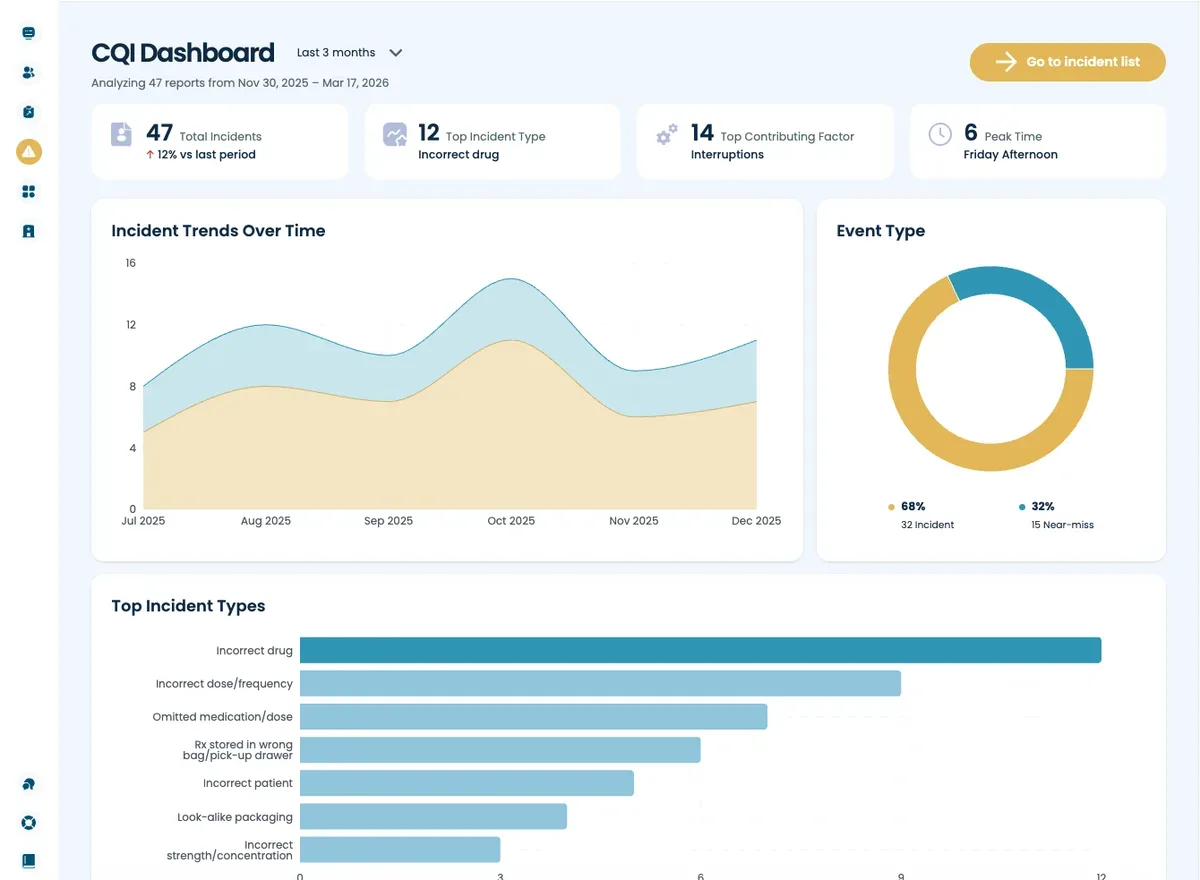
MAPflow includes incident-trend dashboards, contributing-factor analysis, Quick Win suggestions, meeting notes and action tracking. Those features can help a team prepare a useful CQI meeting, record the interventions agreed upon and evaluate whether they were implemented. They do not replace the meeting itself. OCP requires quarterly CQI meetings beginning with the first by April 1, 2027. OCP checklist. MAPflow suggests each next Ontario meeting three months after the last one and shows a banner when one is overdue.
MAPflow’s Quick Wins are suggested improvement actions for team review. Pharmacists and technicians remain responsible for professional judgment and local practice decisions.
MAPflow AIMS criteria: What to ask in a demonstration
A useful demo can move through six actions without changing the subject to unrelated software features:
- Create a medication incident and show all required OCP fields.
- Create a near miss and show the correct degree-of-harm exception.
- Review contributing factors and create an action plan with an owner and status.
- Show the CQI dashboard and how meeting notes, attendees and actions are retained.
- Demonstrate individual registered-staff accounts and how team members are invited.
- Explain anonymous NIDR field mapping and how each completed report is sent.
Ask for instructions on your pharmacy’s own Data Sharing Agreement. For pricing, see the MAPflow AIMS pricing breakdown. For the legal and clinical program context, the complete AIMS guide remains the main reference.
MAPflow AIMS criteria: Frequently asked questions
Does OCP endorse specific AIMS platforms?
No. OCP states that it “does not approve or endorse specific platforms.” Each pharmacy is responsible for choosing a platform that meets the criteria. MAPflow has completed technical testing with ISMP Canada for NIDR submissions.
Does MAPflow support medication incidents and near misses?
Yes. MAPflow’s guided form covers all 15 of OCP’s mandatory fields. For a near miss, staff choose “Near miss / good catch” as the impact level, which drops degree of harm. Ask for a demonstration using your pharmacy’s actual reporting scenarios.
Does MAPflow upload data to the NIDR automatically?
Yes. Completing a report sends its anonymous NIDR data immediately, and Ontario uploads run from January 1, 2027. OCP requires daily anonymous uploads. The pharmacy must separately complete its ISMP Canada Data Sharing Agreement.
Is a medication safety self-assessment included?
Yes. MAPflow Incident Reporting includes the ISMP Canada MSSA, at most once per pharmacy per subscription year. OCP requires completing a validated SSA at least every two years.
Is using MAPflow alone enough to satisfy all AIMS obligations?
No. The pharmacy still needs to complete its agreement and training, provide suitable accounts, report and review incidents, hold CQI meetings and undertake safety self-assessments and improvements.