Yes. Registered pharmacy technicians have responsibilities under Ontario’s AIMS program, alongside pharmacists. The Ontario College of Pharmacists’ (OCP) updated supplemental Standard of Practice says both groups must manage medication incidents, address unsafe practices, document and communicate incidents and near misses, and contribute to continuous quality improvement (CQI). AIMS reporting is for technicians too. The pharmacist does not have to be the only person who recognizes or records a safety concern. See the updated AIMS standard.
Choosing a platform? See how MAPflow Incident Reporting supports AIMS
On this page
AIMS reporting for technicians: key dates at a glance
-
Now through 2026
Keep recording incidents and near misses
Until your platform is live, record events locally. OCP's optional Medication Event Reporting Form is for internal use only. OCP, January 6, 2026
-
Once you choose a platform
Complete the Data Sharing Agreement online
The Designated Manager creates an account on ISMP Canada's NIDR portal, adds the pharmacy and signs the agreement there. Chains may have one corporate submitter. OCP, October 22, 2026
-
By January 1, 2027 Next deadline
Have a qualifying platform in place
Implement a qualifying reporting platform, create individual logins for registered staff at their primary place of practice, and ensure pharmacy staff complete OCP's AIMS e-Learning modules. OCP Designated Manager checklist
-
Every day from then on
Anonymous uploads to the NIDR
Your platform uploads incident and near-miss data to ISMP Canada daily. OCP platform criteria
-
By April 1, 2027
Hold your first CQI meeting
Then meet at least once every quarter. OCP Designated Manager checklist
-
At least every two years
Complete a safety self-assessment
A validated tool: the ISMP Canada MSSA or the Think Research (Pharmapod) PSSA. OCP platform criteria
A separate issue is who needs their own platform login from January 1, 2027. That requirement applies to registered pharmacists and pharmacy technicians at their primary place of practice, with a specific exemption for relief and occasional staff. This guide explains the distinction and gives practical examples without expanding OCP’s requirements beyond what is published. For the complete program, see Ontario AIMS requirements for 2027.
AIMS reporting for technicians: What OCP actually requires
AIMS stands for Assurance and Improvement in Medication Safety. It is a mandatory program intended to support learning from medication incidents and near misses in Ontario pharmacies. OCP’s four components are report, document, analyze and share learning. This is a team process, not a task reserved for a Designated Manager or the pharmacist on duty.
OCP’s updated supplemental standard, effective January 1, 2027, says that all pharmacists and pharmacy technicians have a responsibility and obligation to manage medication incidents and address unsafe practices. It includes documenting and communicating events to pharmacy staff and, where appropriate, to the patient and other healthcare providers. It also expects pharmacy professionals to engage in CQI planning and improvement initiatives. Read the standard.
Reporting is a shared responsibility
A pharmacy technician might notice an incorrect quantity during the technical check, discover a discrepancy between a label and the product, or learn about a dispensing problem reported by a patient. Those observations should be brought into the pharmacy’s established safety workflow. The immediate response still depends on the seriousness of the event, the technician’s scope of practice, the pharmacist’s clinical responsibilities and local procedures.
AIMS does not authorize a technician to make clinical decisions outside their scope, nor does it imply that the person entering the record is solely responsible for reviewing every clinical consequence. It requires the team to act appropriately, document, analyze contributing factors and share the lesson.
What changed, and what did not?
The underlying duty to learn from medication incidents is not new in 2027. OCP’s January 2026 transition article instructed pharmacy professionals to continue recording, documenting, analyzing and sharing medication safety events during 2026, even if no new platform had been selected. January 2027 introduces the updated standard, qualifying platform requirements, individual access rules and other defined milestones. Our January 2027 explainer covers the dates.
AIMS reporting for technicians: Incidents versus near misses
OCP defines a medication incident as a preventable event or error that reaches a patient and may cause or lead to inappropriate medication use or harm. A near miss is intercepted before it reaches the patient. Both matter because the goal is to identify what made an error possible and reduce the risk of recurrence. The OCP AIMS program page sets out these definitions.
Practical, hypothetical examples
Example 1: a good catch during a normal check. A technician detects a wrong drug identification number during the pharmacy’s established technical sign-off, corrects it, and flags a recurring barcode problem. OCP’s article on near misses says that when more than one near miss occurs under similar circumstances, it should be considered recurring and reported. OCP’s near-miss FAQ adds that errors re-occurring on a frequent basis may mean the pharmacy’s processes are not working and should be reviewed.
Example 2: a near miss outside routine checks. A bag is prepared for the wrong patient. A team member notices the mismatch by chance after the normal sign-offs, before it reaches the patient. OCP’s near-miss FAQ says a potential error caught outside the pharmacy’s established processes and procedures, but before the prescription reaches the patient, should be recorded as a near miss. It gives the technical and therapeutic sign-offs and routine input or DIN checks as examples of established processes.
Example 3: an event that reached the patient. A patient reports that a dispensed medication is not the one expected. The pharmacy first verifies what happened, since a generic substitution or a planned change can look the same to a patient. If a dispensing error is confirmed, the pharmacist promptly assesses the patient’s safety, and the team documents what happened and works through the CQI process. Recording AIMS information does not replace patient care or any separately applicable notification requirement.
These examples illustrate classifications and workflow considerations; they are not real MAPflow user incidents.
Is every single correction and near miss recorded identically?
OCP’s August 26, 2026 news release says pharmacy professionals must report all medication incidents and near misses. OCP’s near-miss FAQ adds an important nuance: the extent of near-miss recording is a professional judgment decision for the Designated Manager, considering patient-safety implications, the event’s nature and recurrence. That nuance should be reflected in staff training; saying every routine correction automatically requires the same full report would oversimplify the guidance.
AIMS reporting for technicians: Individual login rules for 2027
OCP’s October 22 platform criteria and Designated Manager checklist require unique accounts for pharmacists and registered pharmacy technicians whose primary place of practice is the pharmacy. The stated purpose is secure access and accountability. A shared login for all registered team members does not satisfy that individual-login expectation.
| Person | Mandatory unique login at this pharmacy? | Safety reporting responsibility? |
|---|---|---|
| Pharmacist whose primary practice is here | Yes | Yes |
| Registered pharmacy technician whose primary practice is here | Yes | Yes |
| Relief or occasional pharmacist or technician | Exempt from this specific login rule | Yes, as appropriate to the role and situation |
| Pharmacy assistant or other unregulated staff member | Not mandated by this rule; access at DM discretion | Follow pharmacy policies and promptly communicate safety concerns |
The exception is about account provisioning, not permission to ignore a medication incident. If a relief technician detects an issue, the team still needs a reliable process to report, review and act on it. Your Designated Manager should determine how the chosen platform and local procedures support that workflow.
Who can read or edit a report?
The OCP criteria mandate individual registered-staff access, but they do not prescribe identical permissions for every user. A pharmacy should decide who can create, amend, review and close records, and how sensitive details are protected. Ask the vendor how user identity and changes are recorded. A vendor’s role model should support the pharmacy’s policies, not override professional accountability.
AIMS reporting for technicians: Training and the daily workflow
OCP’s Designated Manager checklist calls for pharmacy staff to complete its five AIMS e-Learning modules by January 1, 2027, and to receive training on the incident management platform used at the pharmacy. The official module library covers the value of reporting, documentation, analysis, sharing learnings and safety culture.
A useful training session should answer practical questions. Where do you find the report form during a busy shift? How do you decide whether an event reached the patient? What details are useful without including unnecessary identifiers in information sent to the NIDR? Who reviews an urgent event? How does the team know a corrective action has actually happened?
A five-step workflow technicians can practise
- Protect the patient first. Escalate any potential harm promptly according to scope, pharmacy policy and clinical urgency.
- Record the event or near miss. Include the factual sequence, relevant medication details and the stage where it was discovered; avoid blame-oriented speculation.
- Help identify contributing factors. Consider workflow, look-alike packaging, interruptions, labelling or system issues, as appropriate to the event.
- Share the finding. Make sure the appropriate colleagues know about risks that require immediate attention or a wider discussion.
- Participate in follow-up. Help evaluate whether the agreed changes have been implemented and whether similar events continue.
For the pharmacy, the selected platform must support anonymous daily uploads to ISMP Canada’s NIDR, but this is a platform-level reporting requirement. It does not mean each technician manually sends an individual file to ISMP Canada every evening. Review the OCP platform criteria for the data-sharing distinction.
AIMS reporting for technicians: Building a team culture
A reporting system is less useful when people feel unsafe raising problems. The updated OCP standard calls for an environment that supports learning and accountability over blame and punishment. A pharmacy technician who notices a recurring issue should be able to explain it without having to prove a single colleague caused it.
The Designated Manager remains responsible for providing the conditions and procedures that enable safe reporting. But technicians can contribute valuable knowledge of dispensing workflow, technical checks, packaging and handoffs. Those perspectives help the team find system-level weaknesses that might be invisible when only one role reviews events.
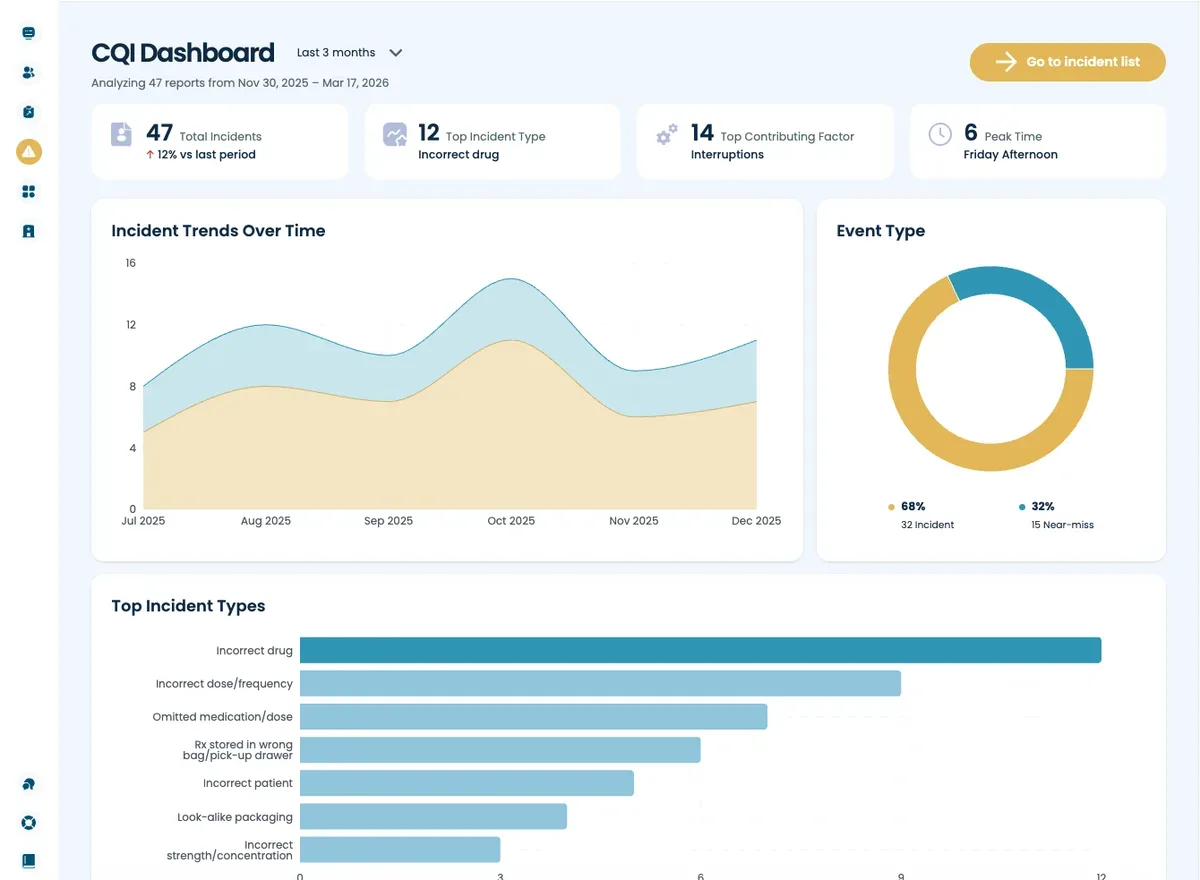
MAPflow Incident Reporting includes a guided reporting form, a shared incident history and CQI action tracking. If you’re comparing solutions for your whole team, see how to choose an AIMS platform and the MAPflow criteria walkthrough. In MAPflow, every staff member gets their own login: the pharmacy’s administrator invites pharmacists, technicians and assistants by email, and any active member of the team can report.
AIMS reporting for technicians: Frequently asked questions
Do registered pharmacy technicians have to participate in AIMS?
Yes. OCP’s updated standard assigns pharmacists and registered pharmacy technicians responsibilities to manage incidents, document and communicate incidents and near misses, and participate in quality improvement.
Can a technician record a near miss even when no patient was harmed?
Yes. A near miss is intercepted before reaching a patient. OCP’s guidance discusses when it should be recorded and the Designated Manager’s professional judgment about the extent of recording.
Do relief pharmacy technicians need their own AIMS logins?
Relief and occasional technicians are exempt from the unique-login requirement at a primary place of practice. That exception does not remove professional medication-safety responsibilities.
Are pharmacy assistants required to have individual platform accounts?
No. The mandatory unique-login rule applies to registered pharmacists and pharmacy technicians at their primary place of practice. The Designated Manager may grant access to other staff at their discretion.
What AIMS training should a technician complete before 2027?
OCP’s checklist expects pharmacy staff to complete its AIMS e-Learning modules by January 1, 2027, alongside training on the pharmacy’s incident management platform.