Short answer: Ontario pharmacies must participate in the Assurance and Improvement in Medication Safety (AIMS) program, but a pharmacy’s software subscription is different from the National Incident Data Repository (NIDR) processing fee. Ontario College of Pharmacists (OCP) announced in June 2026 that it would cover the annual $70 NIDR processing fee for Ontario pharmacies. Pharmacies still need an incident management platform meeting OCP’s criteria, so AIMS reporting costs vary by provider and what is included.
Choosing a platform? See how MAPflow Incident Reporting supports AIMS
On this page
OCP’s October 22, 2026 program update states the distinction: pharmacies pay for their chosen reporting platform, while the College covers the cost to submit data to the NIDR. OCP’s June 2026 announcement and ISMP Canada’s NIDR information explain the $70 fee. If you need the broader compliance picture first, read our Ontario AIMS requirements guide and January 2027 changes explainer. Here, we focus on what may appear on your pharmacy’s budget.
AIMS reporting costs: Three separate budget lines
AIMS reporting costs are easiest to understand when you separate the platform, NIDR data processing and the safety self-assessment (SSA). These components relate to the same program but are not interchangeable. An offer advertising a low incident-reporting fee may or may not include everything your pharmacy needs.
| Component | What it pays for | What Ontario pharmacies should know |
|---|---|---|
| Incident management platform | Software for capturing incidents and near misses, reviewing events, tracking actions and supporting NIDR uploads | Pharmacy chooses a qualifying provider; commercial terms vary. |
| NIDR processing | National data handling by ISMP Canada | ISMP Canada publishes a $70 annual fee per community pharmacy; OCP announced it will cover this fee for Ontario pharmacies. |
| Validated SSA tool | Periodic structured medication-safety assessment | Must be available through the platform or separately subscribed to; check inclusion before buying. |
The OCP platform criteria require documentation and analysis, action plans, daily anonymous NIDR uploads, individual logins for registered staff at their primary place of practice, and access to a recognized SSA tool. Those requirements matter more than whether a vendor’s invoice has one line or several.
Why the $70 figure causes confusion
ISMP Canada’s national NIDR page states that its data-processing fee is $70 per pharmacy annually and describes how payment can be handled by a pharmacy or a platform provider. That is national information. OCP’s June 1, 2026 AIMS update specifically says OCP will cover the annual $70 NIDR data-processing fee. Ontario pharmacies do not need to budget that $70 as an extra cost.
The October 2026 NIDR Portal User Guide still describes payment and renewals when applicable, including situations where a corporate payor or platform provider pays. That does not negate OCP’s Ontario funding announcement.
AIMS reporting costs: What does the pharmacy actually buy?
A qualifying incident management platform is more than a digital form. Under OCP’s updated criteria, the pharmacy needs a way to document and analyze medication incidents and near misses, document action plans, and send anonymous data to the NIDR daily. The October 22, 2026 program update confirms that pharmacies may select their own provider if it meets the criteria.
Compare features before comparing monthly prices
Ask whether an annual quote covers all team members at one location, the complete incident and near-miss workflow, reporting dashboards, CQI meeting records, technical support and a validated SSA.
A provider may offer a low headline subscription but leave training or the SSA to the pharmacy. Another may bundle several features. Neither model is automatically better.
Distinguish purchase from compliance
Buying software does not complete AIMS. The Designated Manager must arrange the pharmacy’s Data Sharing Agreement through the ISMP Canada portal after selecting a provider, as explained in the OCP checklist. Designated Managers should ensure staff complete OCP’s five AIMS e-Learning modules by January 1, 2027, and receive training on the chosen platform. Quarterly CQI meetings and periodic self-assessments must still happen.
See our platform selection checklist for the questions to put to vendors.
AIMS reporting costs: A real MAPflow price example
To illustrate a straightforward commercial offer, MAPflow’s public Incident Reporting page lists per-pharmacy pricing, billed annually, not a separate fee for every pharmacist or technician.
| MAPflow option | Monthly equivalent | Annual subscription |
|---|---|---|
| Standalone Incident Reporting | $20/month per pharmacy | $240/year |
| Add-on while maintaining MAPflow Clinical Services | $18/month per pharmacy | $216/year |
The difference between these two annual prices is $24, assuming a pharmacy qualifies for the Clinical Services add-on throughout the subscription period. These figures are for the Incident Reporting subscription itself; the Clinical Services subscription is separately priced. Do not add its entire cost to a comparison unless you are deciding whether to purchase both products.
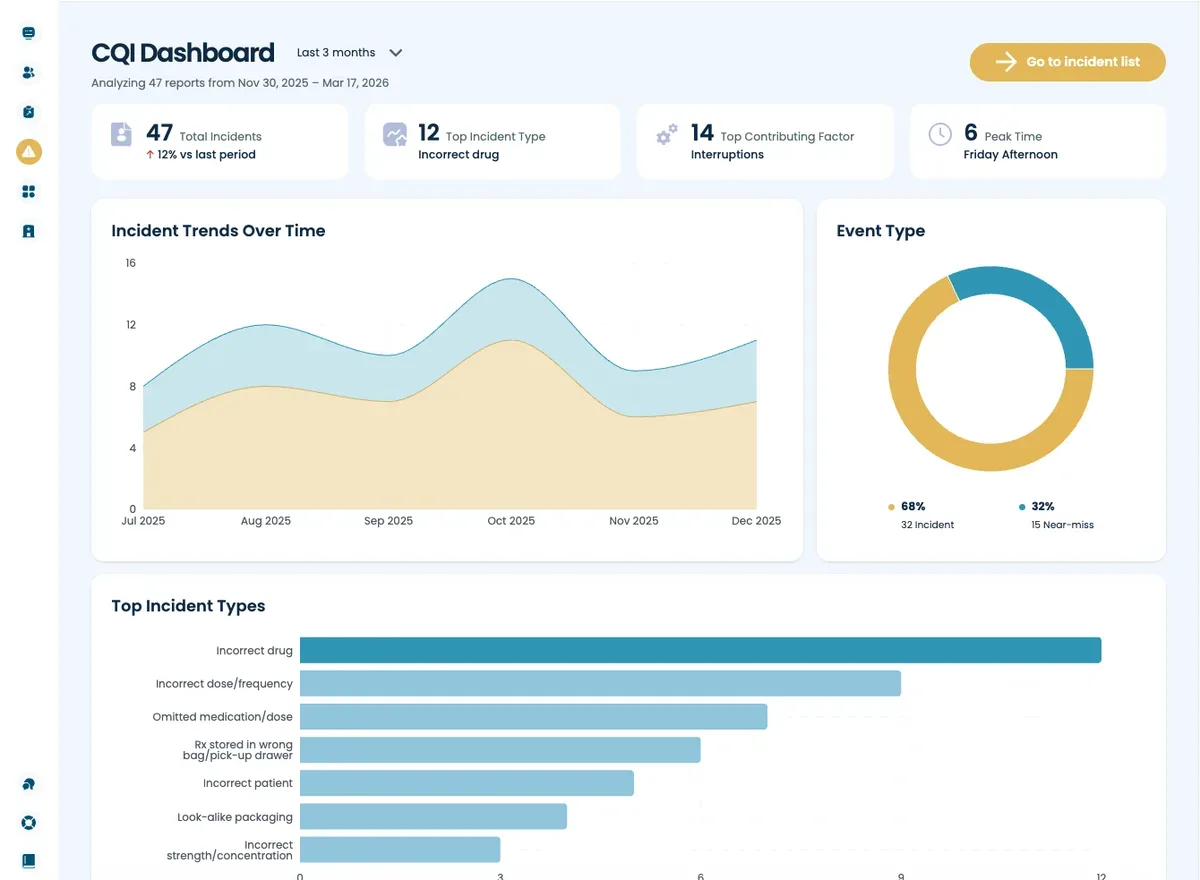
The Incident Reporting subscription includes guided incident reporting, near-miss tracking, trend dashboards, CQI meeting documentation and actions, automated NIDR support, and ISMP Canada’s Medication Safety Self-Assessment (MSSA) for up to one use per pharmacy per subscription year. For more detail, read the MAPflow pricing breakdown and the Ontario product overview.
Does a team of ten pay more than a team of two?
MAPflow’s Incident Reporting charge is per pharmacy, not per individual user, so adding registered staff does not multiply the subscription price: one subscription covers the whole pharmacy team, with no seat limit. You still need individual platform logins for pharmacists and registered pharmacy technicians whose primary place of practice is the pharmacy. Those are access requirements, not per-user billing requirements.
AIMS reporting costs: OPA member offers and eligibility
Ontario Pharmacists Association (OPA) members pay $204 a year for MAPflow Incident Reporting, against $240 regular pricing, as OPA’s MAPflow Incident Reporting listing shows. Incident Reporting is free for 12 months when a member upgrades from an individual MAPflow Clinical Services subscription to a pharmacy license through OPA. OPA Owner Bundle members get Incident Reporting free for 12 months too, and save $300 on a MAPflow Clinical Services pharmacy license, for combined savings of up to $540.
OPA members sign up themselves at mapflow.ca/opa. As with any promotion, these offers can change.
How to compare an OPA promotion fairly
A free introductory period changes first-year cost, not necessarily the ongoing rate. When comparing platforms, calculate the recurring subscription price after the promotion ends, and write down what remains included. If a promotion requires another subscription or membership upgrade, count that commitment too. The useful comparison is the total cost for your own pharmacy, with the terms you can actually obtain.
AIMS reporting costs: Expenses that may be overlooked
The subscription is only one element of implementation. Pharmacies may spend staff time choosing a platform, completing the Data Sharing Agreement, creating accounts, training users, reviewing historical events and scheduling CQI meetings. These are operational commitments, even when a vendor does not charge a separate onboarding fee.
Also plan for the SSA cadence. OCP requires a validated self-assessment at least once every two years, or more frequently if the Designated Manager determines it is appropriate. A separate SSA subscription can change the annual budget if the reporting platform does not include one. OCP recognizes the ISMP Canada MSSA and Think Research/Pharmapod PSSA as nationally available options in its platform criteria.
Ask each vendor to put the included SSA tool and permitted usage in writing. For example, MAPflow Incident Reporting includes the MSSA at most once per pharmacy per subscription year. That is a product entitlement; it is not a claim that OCP requires an annual self-assessment.
Avoid assigning a dollar value to staff time or claiming a particular number of hours saved without a measurement from your own implementation. A sensible planning conversation is more useful than an invented return-on-investment figure.
AIMS reporting costs: Questions to ask before you subscribe
Before approving a purchase, take these questions to the provider and compare the answers side by side:
- Is the rate per pharmacy, per user, per location or per organization?
- What is the total annual subscription, and what changes on renewal?
- Are incident and near-miss reporting, action tracking and daily NIDR support included?
- Is a validated SSA tool included? Which one, and how often can we use it?
- Is there any setup, support, migration, cancellation or export charge?
- Does the provider have documented NIDR testing and required provider-side agreements?
- What must our Designated Manager still complete through ISMP Canada’s NIDR portal?
- Is there an OPA member price or promotion?
A supplier’s answer should distinguish what the product does from what the pharmacy must do to comply. For a broader comparison, see choosing an Ontario AIMS platform, and for the deadline context read what happens in January 2027.
AIMS reporting costs: Frequently asked questions
Is the AIMS program itself a paid OCP subscription?
OCP requires Ontario community pharmacies to participate in AIMS, but pharmacies choose and purchase their incident management platform under the provider’s commercial terms. OCP announced it will cover the annual $70 NIDR data-processing fee; that is separate from the software subscription.
Does OCP cover the $70 NIDR data-processing fee?
Yes. In its June 1, 2026 announcement, OCP said it will cover the annual $70 NIDR processing fee for Ontario pharmacies. Pharmacies must still complete the applicable ISMP Canada Data Sharing Agreement.
Is MAPflow priced per user or per pharmacy?
Per pharmacy. MAPflow’s public Incident Reporting pricing is $240 per year standalone, or $216 per year for pharmacies maintaining a MAPflow Clinical Services plan. Both are billed annually.
Are safety self-assessments included in every reporting platform?
No. OCP requires access to an accepted validated SSA tool. If the chosen platform does not include one, the pharmacy must subscribe separately. MAPflow Incident Reporting includes the ISMP Canada MSSA, at most once per pharmacy per subscription year.
Do OPA members get a different price?
Yes. Ontario Pharmacists Association members pay $204 a year for MAPflow Incident Reporting, against $240 regular pricing. Incident Reporting is free for 12 months when a member upgrades from an individual MAPflow Clinical Services subscription to a pharmacy license through OPA, and for OPA Owner Bundle members, who also save $300 on a MAPflow Clinical Services pharmacy license (up to $540 combined). Members sign up themselves at mapflow.ca/opa.