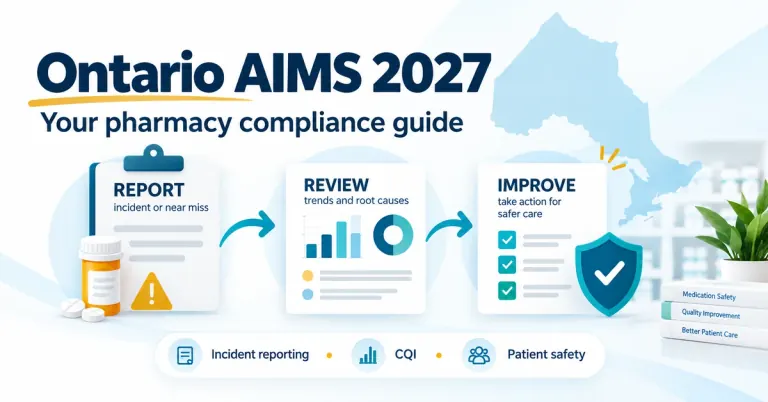
Starting January 1, 2027, Ontario community pharmacies must use an incident management platform that meets the Ontario College of Pharmacists’ (OCP) AIMS criteria and supports reporting to the National Incident Data Repository for Community Pharmacies (NIDR). They must also follow updated expectations for individual staff logins, continuous quality improvement (CQI) meetings and validated safety self-assessments. The deadline does not mean pharmacies can stop documenting incidents and near misses during 2026.
Choosing a platform? See how MAPflow Incident Reporting supports AIMS
On this page
AIMS program January 2027: key dates at a glance
-
Now through 2026
Keep recording incidents and near misses
Until your platform is live, record events locally. OCP's optional Medication Event Reporting Form is for internal use only. OCP, January 6, 2026
-
Once you choose a platform
Complete the Data Sharing Agreement online
The Designated Manager creates an account on ISMP Canada's NIDR portal, adds the pharmacy and signs the agreement there. Chains may have one corporate submitter. OCP, October 22, 2026
-
By January 1, 2027 Next deadline
Have a qualifying platform in place
Implement a qualifying reporting platform, create individual logins for registered staff at their primary place of practice, and ensure pharmacy staff complete OCP's AIMS e-Learning modules. OCP Designated Manager checklist
-
Every day from then on
Anonymous uploads to the NIDR
Your platform uploads incident and near-miss data to ISMP Canada daily. OCP platform criteria
-
By April 1, 2027
Hold your first CQI meeting
Then meet at least once every quarter. OCP Designated Manager checklist
-
At least every two years
Complete a safety self-assessment
A validated tool: the ISMP Canada MSSA or the Think Research (Pharmapod) PSSA. OCP platform criteria
The main source is the College’s AIMS transition page, updated October 22, 2026. This article focuses on the changes and dates; our complete Ontario AIMS requirements guide explains the wider program.
What changes and what continues, at a glance:
| When | What applies |
|---|---|
| Already required in 2026 | Report, document, analyze and share medication incidents and near misses. Pharmacies without their final platform keep local records (OCP, January 2026). |
| Required by January 1, 2027 | A qualifying incident management platform in place, with the Designated Manager’s Data Sharing Agreement with ISMP Canada completed. Individual logins for registered staff at their primary place of practice. Pharmacy staff have completed OCP’s AIMS e-Learning modules and training on the platform (OCP checklist). |
| First milestone afterward | The first quarterly CQI meeting, by April 1, 2027 (OCP checklist). |
| Ongoing | Daily anonymous uploads to the NIDR (OCP criteria), and a validated safety self-assessment at least every two years. |
What changes in the AIMS program on January 1, 2027?
The biggest practical change is the platform deadline. Pharmacies no longer have to use Pharmapod, the formerly mandated platform, and since OCP’s November 2025 timeline announcement they have been able to choose their own incident management platform. January 1, 2027 is the date by which that platform must be in place, meeting OCP’s criteria and able to contribute to the NIDR.
By January 1, pharmacies should have selected and implemented their chosen platform, not merely collected quotations. The Designated Manager also needs to complete a Data Sharing Agreement with ISMP Canada to enable NIDR submissions. The agreement is necessary regardless of which software provider is selected. In a chain or banner, check with your corporate group first, since it may have a designated submitter.
The updated supplemental standard takes effect the same day. It formalizes distinct expectations for registered staff access, periodic CQI meetings and safety self-assessment frequency. These are ongoing professional and pharmacy responsibilities; software can support them but cannot fulfil them automatically without team participation.
OCP has said it will receive confirmation from platform providers about which pharmacies have enrolled (OCP Pharmacy Connection, August 2026). After January 1, 2027, pharmacy staff may be asked to provide proof that their platform meets the College’s criteria and is being used in line with the AIMS Program requirements (OCP AIMS FAQ).
What still applies in 2026, before the AIMS program changes in January 2027?
AIMS stands for Assurance and Improvement in Medication Safety. The program already requires pharmacy teams to report, document, analyze and share learning about medication incidents and near misses. Throughout 2026, pharmacies are expected to maintain those activities even if they have not yet adopted their long-term platform.
If your pharmacy has not chosen software, record events locally. The College offers an optional Medication Event Reporting Form for that purpose. The completed form is for internal use and should not be sent to OCP. Continue reviewing the circumstances, identifying contributing factors and communicating relevant improvements to the team.
This is an important distinction for busy pharmacies. January 2027 changes the technology expectations; it does not create a reporting holiday in 2026. The College reinforced this point in its January 2026 Pharmacy Connection article.
Reporting and daily NIDR uploads under the AIMS program from January 2027
Under the updated AIMS Incident Management Platform Criteria, platforms must support documentation and analysis of all medication incidents and near misses, action plans, and daily anonymous uploads to the NIDR. A near miss is an event caught before the medication reaches the patient. It still provides an opportunity to identify a risk and change a process.
The daily upload requirement is sometimes confused with quarterly CQI meetings. They are different: daily uploads concern anonymous event data sent to the national repository; quarterly meetings concern discussion and improvement at the pharmacy.
The NIDR receives incident information for safety learning. The College says it receives aggregate reporting from the repository rather than pharmacy-specific or identifiable information. Internal records may contain additional details that must be safeguarded; not all fields captured locally are currently transmitted to the repository.
Designated Managers complete the Data Sharing Agreement online, in ISMP Canada’s NIDR portal. The October 2026 NIDR Portal User Guide explains how to create or access an account, identify the pharmacy and submit the agreement. It is worth completing this early rather than discovering an account issue near the deadline.
Unique logins and team roles in the AIMS program from January 2027
The updated standard requires unique logins for pharmacists and registered pharmacy technicians at their primary place of practice. Relief or occasional pharmacists and technicians are exempt from this particular requirement. OCP’s Designated Manager checklist adds that other pharmacy staff may be given access at the Designated Manager’s discretion; unregulated staff, such as pharmacy assistants, are not required to have it.
Unique logins support secure access and make it clearer who entered or updated information. But account creation is only one step: pharmacy staff must know what qualifies as an incident or near miss, where to document it, who reviews it and how urgent concerns are escalated.
OCP’s August 2026 news update reminds pharmacy professionals that all incidents and near misses must be reported. A wrong strength noticed after the final check, but before the patient picks up the prescription, is a near miss worth recording even though no medication reached the patient. OCP’s AIMS FAQ adds that the extent to which near misses are recorded is a professional judgment decision of the Designated Manager. Staff should also understand that incident reporting does not replace appropriate patient care or other notification responsibilities.
CQI meetings and self-assessments in the AIMS program after January 2027
Two requirements are easy to overlook because they have different timing from the platform launch.
Quarterly CQI meetings: The updated AIMS standard requires meetings at least once per quarter. According to OCP’s checklist for Designated Managers, the first meeting must take place by April 1, 2027. Keep a record of attendees, themes discussed and improvement actions. OCP also supplies a sample meeting agenda.
Validated safety self-assessment: Pharmacies must complete an accepted safety self-assessment at least once every two years, or more often if needed. OCP identifies the ISMP Canada Medication Safety Self-Assessment (MSSA) and the Think Research (Pharmapod) Pharmacy Safety Self-Assessment (PSSA) as accepted national tools. If a software subscription does not include access to a validated tool, the pharmacy must obtain access separately.
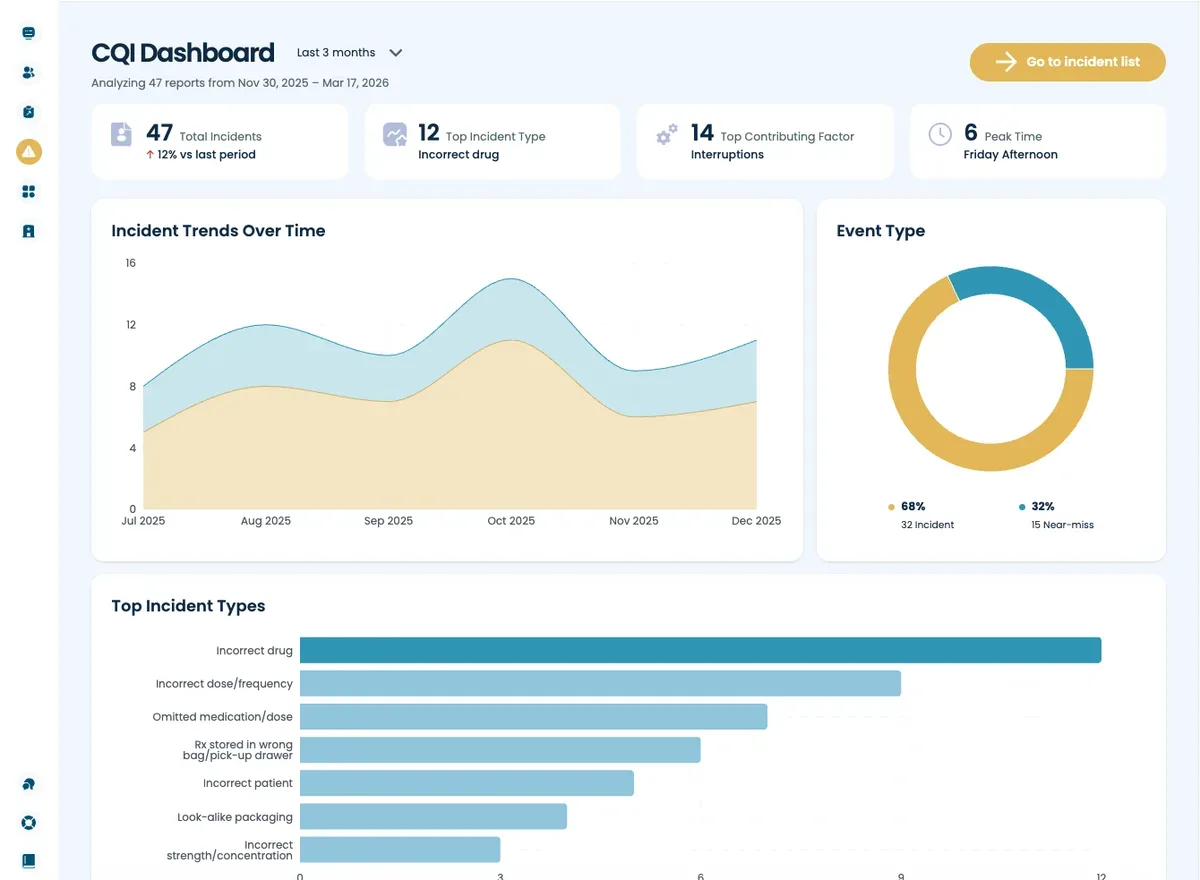
A CQI meeting is not simply a submission deadline. It is a time to look at patterns, consider why an error or near miss occurred, assign actions and check whether changes were implemented. Fewer reports do not automatically mean fewer safety problems; reporting practices and team confidence can affect the numbers. A tool such as MAPflow’s CQI dashboard can bring the patterns to the meeting.
Platform costs and provider claims for the AIMS program in January 2027
OCP lets pharmacies choose among providers that meet its criteria. Pharmacies cover the costs of their selected platform, while the College covers the cost of submitting data to the NIDR. Pharmacy decision-makers should compare the complete reporting and CQI workflow, not simply the sign-up price.
Importantly, OCP does not approve or endorse specific vendors. It publishes criteria and identifies providers that have completed NIDR testing and have an agreement in place with ISMP Canada. MAPflow has completed technical testing with ISMP Canada for NIDR submissions. The OCP’s publicly posted platform list may not yet reflect the latest testing status.
For a software example, MAPflow Incident Reporting provides guided incident and near-miss reporting, CQI analytics and meeting/action tracking. Its Ontario AIMS page describes the Ontario workflow. It costs $240 per pharmacy per year, or $216 per year for MAPflow Clinical Services customers, billed annually, and one subscription covers the whole pharmacy. Eligible Ontario Pharmacists Association members may also get member pricing.
A simple readiness plan for the AIMS program in January 2027
The practical steps are manageable if they are assigned and verified before the deadline.
- Now: Read OCP’s updated criteria and confirm how your pharmacy records incidents and near misses during the remainder of 2026.
- Before January 1: Select and implement a reporting platform, and complete the pharmacy’s Data Sharing Agreement with ISMP Canada in its NIDR portal.
- Before January 1: Set up individual accounts for registered pharmacists and pharmacy technicians whose primary practice is the location; document access and review responsibilities.
- Before January 1: Ensure pharmacy staff complete OCP’s five AIMS e-Learning modules by January 1, 2027, and train them to use your chosen incident management platform, including incident and near-miss reporting and patient safety escalation.
- By April 1, 2027: Hold the first quarterly CQI meeting and document the discussion and actions.
- At least every two years: Complete a validated SSA and track the follow-up work. OCP hasn’t said whether an assessment done before 2027 starts the two-year clock, so check with OCP if you’re unsure.
For the full field-level criteria and a longer checklist, go to the Ontario AIMS requirements resource hub. MAPflow’s February 2026 product announcement gives background on how the platform was designed for pharmacy teams.
FAQs about the AIMS program in January 2027
What exactly happens on January 1, 2027?
Ontario community pharmacies must have implemented an incident management platform that meets the College’s AIMS criteria and supports NIDR reporting. The updated supplemental standard also takes effect.
Can a pharmacy wait until 2027 to start recording near misses?
No. Reporting, documenting, analyzing and sharing lessons from medication incidents and near misses remain expected during 2026. Pharmacies without their final platform must continue local recording.
Must every pharmacy use Pharmapod in 2027?
No. OCP allows pharmacies to select a qualifying provider of their choice, provided the platform meets the criteria and can contribute to the NIDR. See how MAPflow compares with Pharmapod.
Do pharmacies submit incident reports daily or quarterly?
The platform criteria require daily anonymous NIDR uploads. Separately, a pharmacy must hold CQI meetings at least quarterly.
When is the first required CQI meeting?
The first quarterly CQI meeting must take place by April 1, 2027, according to OCP’s Designated Manager checklist.
Does OCP approve MAPflow or other incident management software?
OCP does not approve or endorse individual products. It publishes criteria and a list of providers that have completed NIDR testing and have the requisite agreement with ISMP Canada. Check the current list for the latest provider status.