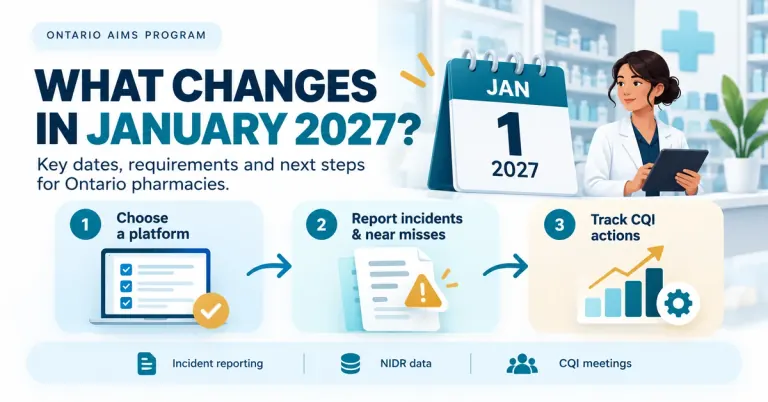
The short answer: By January 1, 2027, Ontario community pharmacies must have an incident management platform that meets the Ontario College of Pharmacists’ (OCP) AIMS criteria and uploads anonymous incident and near-miss data to the National Incident Data Repository for Community Pharmacies (NIDR) daily. The Designated Manager completes ISMP Canada’s Data Sharing Agreement, registered staff get individual logins, and the first quarterly continuous quality improvement (CQI) meeting is due by April 1, 2027.
Choosing a platform? See how MAPflow Incident Reporting supports AIMS
Explore Ontario AIMS topics
On this page
Ontario AIMS requirements: key dates at a glance
-
Now through 2026
Keep recording incidents and near misses
Until your platform is live, record events locally. OCP's optional Medication Event Reporting Form is for internal use only. OCP, January 6, 2026
-
Once you choose a platform
Complete the Data Sharing Agreement online
The Designated Manager creates an account on ISMP Canada's NIDR portal, adds the pharmacy and signs the agreement there. Chains may have one corporate submitter. OCP, October 22, 2026
-
By January 1, 2027 Next deadline
Have a qualifying platform in place
Implement a qualifying reporting platform, create individual logins for registered staff at their primary place of practice, and ensure pharmacy staff complete OCP's AIMS e-Learning modules. OCP Designated Manager checklist
-
Every day from then on
Anonymous uploads to the NIDR
Your platform uploads incident and near-miss data to ISMP Canada daily. OCP platform criteria
-
By April 1, 2027
Hold your first CQI meeting
Then meet at least once every quarter. OCP Designated Manager checklist
-
At least every two years
Complete a safety self-assessment
A validated tool: the ISMP Canada MSSA or the Think Research (Pharmapod) PSSA. OCP platform criteria
The work does not stop at buying software. Pharmacies must continue to document, analyze and learn from medication incidents and near misses, support individual access for registered team members, conduct quarterly CQI meetings and complete a validated safety self-assessment at least every two years. The College’s AIMS transition page, updated October 22, 2026, is the central source for the transition.
For a quick explanation of the deadline alone, read What Happens to the AIMS Program in January 2027?. For software features, visit MAPflow Incident Reporting or its Ontario-specific page.
What are the Ontario AIMS requirements for pharmacies?
AIMS stands for Assurance and Improvement in Medication Safety. It is the OCP’s mandatory medication safety program for Ontario community pharmacies, intended to help pharmacies learn from errors, identify weaknesses in processes and reduce the risk of similar events happening again. Incident reporting is one component of AIMS, not the entire program.
Think of AIMS as a learning cycle. A team notices a medication incident or near miss. It records what happened, documents relevant details, examines contributing factors, takes corrective action and shares the learning. Over time, the pharmacy looks at individual events and recurring patterns to make safer processes part of everyday practice.
Four responsibilities behind the program
OCP organizes the work around report, document, analyze and share. Reporting captures events and near misses. Documentation records the facts and the pharmacy’s response. Analysis looks beyond individual actions to the conditions that made an error possible. Sharing brings the learning back to the team and informs improvements.
This is why a report alone is not proof of effective CQI. A log containing hundreds of incidents but no follow-up actions, staff conversations or evaluation of changes would not demonstrate the complete learning process described in the updated supplemental Standard of Practice.
What counts as an incident or a near miss?
OCP defines a medication incident as “any preventable event or error that reaches a patient and that may cause or lead to inappropriate medication use or patient harm.” A near miss is “an event that could have led to inappropriate medication use or patient harm but was intercepted before it reached the patient” (OCP AIMS Program). Some teams call a near miss a good catch. For example, noticing the wrong strength after the final check, but before the patient picks up the prescription, is a near miss. It still reveals an opportunity to improve the process.
Both deserve attention. The College’s August 26, 2026 news update about reporting incidents and near misses says pharmacy professionals must report all medication incidents and near misses. OCP’s AIMS FAQ adds that a potential error caught outside the pharmacy’s established processes, such as the technical and therapeutic sign-offs, but before the prescription reaches the patient should be recorded as a near miss. It also says the extent to which near misses are recorded is a professional judgment decision of the Designated Manager, based on the nature of the near miss, its implications for patient safety and whether it recurs.
How Ontario AIMS requirements change on January 1, 2027
The January deadline is mainly a change to the platform and an updated set of practice expectations, not the start of medication safety reporting. Reporting, documentation, analysis and shared learning already apply during the 2026 transition year.
What must be ready by January 1?
According to the OCP transition page, pharmacies must select and implement an incident management platform that meets the College’s criteria. Its functionality must support reporting to the NIDR. The Designated Manager must also complete a Data Sharing Agreement with ISMP Canada, regardless of the platform chosen. Buying software doesn’t replace this agreement.
The updated standard also brings a requirement for unique platform logins for registered pharmacy staff at their primary place of practice, with relief and occasional staff exempt. Pharmacy teams must be ready to follow the updated standard from January 1.
OCP has said it will receive confirmation from platform providers about which pharmacies have enrolled with their platform (OCP Pharmacy Connection, August 2026). After January 1, 2027, pharmacy staff may be asked to provide proof that their platform meets the College’s criteria and is being used in line with the AIMS Program requirements (OCP AIMS FAQ).
What continues throughout 2026?
If your pharmacy has not yet chosen its final platform, it must still record medication incidents and near misses locally. OCP provides an optional Medication Event Reporting Form. The form is for internal use and should not be sent to the College. Teams must also continue documenting and analyzing events and communicating lessons learned. OCP explained these responsibilities in its January 2026 Pharmacy Connection article.
The practical implication is straightforward: do not stop reporting while comparing software. Maintain a consistent record now, then establish a clear transition process for your selected platform. Ask vendors how historical records will be retained or referenced; do not assume that data automatically transfers between providers.
The deadlines after January
The OCP Designated Manager checklist gives two important follow-on dates or frequencies. The first quarterly CQI meeting is to occur by April 1, 2027, with meetings at least once every quarter thereafter. A validated safety self-assessment must be completed at least once every two years, or more often when the Designated Manager determines it is needed. The checklist does not set a blanket January 1 deadline for every pharmacy to complete a new self-assessment; it requires the ongoing biennial schedule.
For the dates in one place, see our January 2027 changes explainer.
Ontario AIMS requirements for recording incidents and near misses
Choosing a compliant platform starts with understanding the information your pharmacy needs to record. OCP’s AIMS Incident Management Platform Criteria list 15 data fields for each incident. Near misses need the same fields except the degree of harm, because the event was intercepted before it reached the patient.
What information should the reporting workflow capture?
The criteria name the fields:
- Date incident occurred
- Time incident occurred
- Patient date of birth (age range)
- Patient gender
- Type of incident, for example incorrect drug or incorrect patient
- Incident discovered by, for example pharmacist or patient
- Medication prescribed by, meaning the type of prescriber, for example physician or pharmacist
- Medication system stages involved, for example prescribing or order entry
- Medication(s) involved
- Route of administration
- Associated factors, one or more of: central fill, compliance packaging, compounded medication, injection by a pharmacy professional, transition of care, or none of the above
- Degree of harm to the patient (incidents only)
- Incident description, in free text
- Contributing factors
- Actions taken at the pharmacy level in response
Some fields help identify patterns across many events, such as the associated factors and the medication system stages. A structured form makes records easier to compare, but it should also let staff describe important details in their own words.
Capturing information is different from submitting it
OCP notes that some mandatory data fields are not currently part of the data shared with ISMP Canada. Pharmacies still need to collect and retain those fields in their own incident management platforms. In other words, the fields needed for an internal record and the fields sent anonymously to the NIDR are not necessarily identical.
This distinction matters for privacy. A pharmacy may need enough internal detail to investigate an event and manage patient care, but external NIDR reporting must follow the applicable anonymization and data-sharing rules. Pharmacy owners and Designated Managers remain responsible for safeguarding information in their systems. Platform functionality does not remove professional or organizational privacy obligations.
What should happen after a report is filed?
A useful workflow identifies who reviews the event, when immediate safety concerns are escalated, how contributing factors are recorded and how a corrective action is followed through. Depending on the circumstances, the pharmacy may also need to contact the patient, prescriber or another healthcare professional. Reporting to AIMS does not replace appropriate clinical follow-up or other applicable notification responsibilities.
Consider a repeated look-alike packaging near miss. It may warrant separating stock, adding a shelf warning, revising a checking step and reviewing whether the change worked. These are illustrations of improvement actions, not proof that any specific action will eliminate future errors. The learning process should be proportionate to the event and the pharmacy’s circumstances.
Ontario AIMS requirements for daily NIDR uploads
The National Incident Data Repository for Community Pharmacies (NIDR) is operated by the Institute for Safe Medication Practices Canada (ISMP Canada). Its role is to support learning from medication safety data beyond a single pharmacy. The OCP receives aggregate data from the NIDR, not pharmacy-identifiable information, according to its platform criteria.
Daily upload is the platform requirement
The current OCP criteria call for anonymous incident and near-miss data to be uploaded daily. This is not a quarterly NIDR submission requirement. Quarterly CQI meetings are a separate requirement, and confusing the two could produce the wrong software configuration or workflow.
Daily upload also does not mean every pharmacy professional must manually submit a file every day. A suitable system can support automated transmission, subject to its design and the pharmacy’s completed agreement. When evaluating software, ask how the provider handles validation failures, outages, missing mandatory information, rejected records and successful-upload confirmations.
Each pharmacy needs a Data Sharing Agreement
The College says Designated Managers must sign a Data Sharing Agreement with ISMP Canada after selecting a platform. The agreement is now completed online in a few steps: the Designated Manager creates an account on ISMP Canada’s NIDR portal, adds the pharmacy, then reviews and submits the agreement. The official NIDR Portal User Guide walks through each step and covers changes such as a new pharmacy manager, owner or reporting provider.
Chains and banners can work differently. ISMP Canada says corporate groups may have a designated submitter, so Designated Managers of corporate pharmacies should check with their corporate group before submitting the agreement.
An agreement between a software supplier and ISMP Canada is not a substitute for the pharmacy’s own agreement. Build this administrative task into onboarding rather than treating it as an afterthought.
Questions to ask a software provider
Ask whether NIDR transmission has been tested; how daily uploads are scheduled; which fields are sent; how identifiable details are protected; how exceptions are handled; and what the pharmacy can see to confirm submission status. Request written explanations for any functionality still in development. A demonstration of a reporting form alone cannot establish that the whole end-to-end data flow meets the College’s criteria.
Ontario AIMS requirements for staff logins and accountability
From January 1, 2027, pharmacists and registered pharmacy technicians must have individual platform logins at their primary place of practice, with an exception for relief or occasional staff. OCP introduced this expectation to improve access, secure records and accountability.
Registered staff and the wider pharmacy team
Pharmacists and pharmacy technicians both have responsibilities to manage incidents and address unsafe practice. The updated supplemental standard describes obligations to document and communicate incidents and near misses with the team and, where appropriate, the patient and other providers. The login requirement covers registered staff only. OCP’s Designated Manager checklist adds that access may be granted to other pharmacy staff at the Designated Manager’s discretion, and OCP’s AIMS FAQ notes that unregulated staff, such as pharmacy assistants, are not required to have access.
This makes roles and permissions important. A pharmacy should decide who can create a report, who can review potentially identifiable internal details, who can amend information, and who can close an action. The right configuration will depend on staffing and the provider’s permission model.
Make access practical, not just compliant on paper
If team members share a generic account, it becomes harder to trace changes and manage permissions. If individual accounts are difficult to access, reporting can be delayed. Plan for new hires, departures, forgotten passwords and staff working at more than one location. Ensure training explains when staff should report a near miss and how to raise an urgent patient safety issue without waiting for a routine review.
Before rollout, ask your vendor whether individual logins, role-based access and audit records are supported. For details about MAPflow’s workflows, see the incident reporting platform overview.
Ontario AIMS requirements for CQI meetings and safety self-assessments
Continuous quality improvement (CQI) connects incident data to changes in practice. A pharmacy that records events but never discusses patterns is missing a major part of the AIMS purpose. The updated standard formalizes a minimum meeting frequency and safety self-assessment cycle.
Quarterly CQI meetings
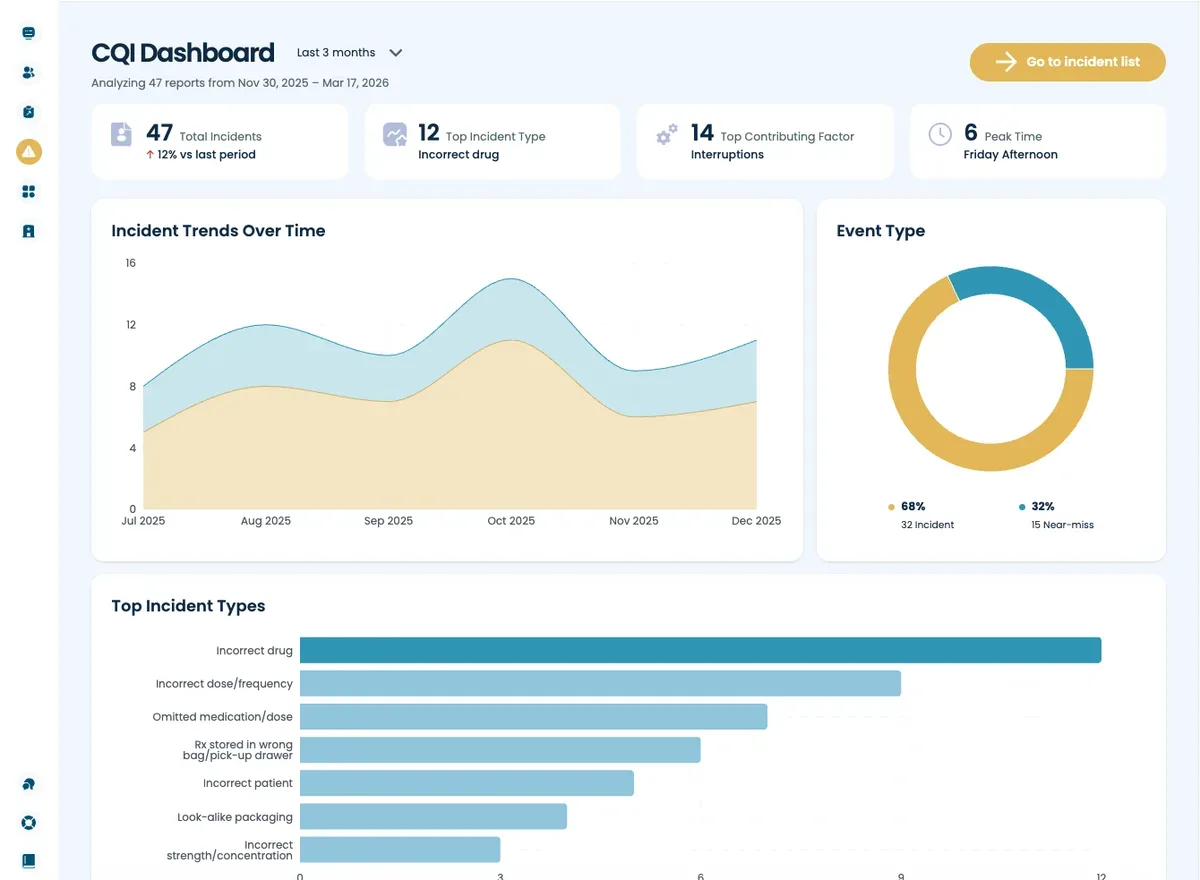
Pharmacies must hold CQI meetings at least once every quarter, with the first meeting due by April 1, 2027. OCP’s sample meeting agenda can help with preparation. A useful meeting might review recent incident and near-miss patterns, progress against open action items, staff feedback, and whether prior changes appear effective. Software can prepare part of this: MAPflow’s CQI dashboard, for example, shows your most common incident type and top contributing factor.
Keep a record of the meeting, attendees, discussion and follow-up actions. Avoid reducing the meeting to a formality. If the team decides to reorganize storage for a high-risk medication, agree on the owner, completion date and method for checking whether the intervention was implemented.
Validated safety self-assessments
A safety self-assessment (SSA) prompts a structured review of practices that could expose patients to medication risk. OCP requires a validated assessment at least every two years. Its criteria identify the ISMP Canada Medication Safety Self-Assessment (MSSA) and the Think Research (Pharmapod) Pharmacy Safety Self-Assessment (PSSA) as accepted national tools. If your incident management platform does not include access to an accepted tool, your pharmacy must subscribe to one separately.
The self-assessment is not the same as a CQI meeting. It can inform a meeting and help prioritize improvement work, but it has a distinct requirement and cadence. Record when it was completed and what follow-up actions the team selected. Consult OCP if you are uncertain how the timing applies to your pharmacy’s prior completed assessment.
Measure actions rather than promise outcomes
Useful measures may include the number and type of events reported, repeated contributing factors, completion of agreed actions and staff participation in reviews. An increase in reports does not necessarily mean the pharmacy suddenly became less safe; improved awareness and willingness to report can also change the numbers. Compare trends with context instead of equating a low report count with high performance.
How to choose software that supports Ontario AIMS requirements
OCP no longer mandates a single reporting provider. Pharmacies may choose their own platform if it meets the criteria and can contribute to the NIDR. That is a meaningful change from the earlier Pharmapod requirement, but it places more responsibility on pharmacy decision-makers to assess the proposed solution.
Use the College’s criteria, not marketing labels
Review the current AIMS Incident Management Platform Criteria before purchasing. Verify incident and near-miss coverage, all mandatory fields, action plans, NIDR submissions, appropriate user access, access to a validated SSA tool, and data protection. Ask for a demonstration using a realistic near miss, not just a completed incident. Then ask the vendor to show how that near miss moves from reporting through analysis and corrective action.
The criteria also describe the College’s list of providers that have completed NIDR transmission testing and have an executed agreement with ISMP Canada, as well as providers still testing. OCP explicitly says it does not approve or endorse individual platforms. Look for documented alignment and current evidence, not a claim of regulatory endorsement.
Evaluate what happens when something goes wrong
Software is part of a pharmacy safety process, so edge cases matter. Ask what happens if internet access fails, a record cannot be uploaded, a staff member reports a serious event, or a report needs correction. Check how records can be searched or exported for internal review. Clarify whether automated prompts are suggestions or final decisions; professional judgment and local policies still matter.
Price matters too, but compare the whole workflow. A lower subscription price may not include a validated safety self-assessment tool or the CQI action tracking your team needs. Conversely, a long list of dashboard features does not guarantee a platform meets mandatory NIDR and privacy criteria.
A practical checklist for Ontario AIMS requirements before January 2027
Use this operational checklist alongside the College’s own Designated Manager checklist. It is a planning aid, not a replacement for the official standard.
Before choosing a platform
- Review the October 2026 OCP guidance and the updated supplemental standard.
- Assign a pharmacy owner or Designated Manager to lead implementation.
- Confirm how incidents and near misses are currently recorded; do not pause reporting during selection.
- Compare candidate platforms against the current OCP criteria, including daily NIDR uploads and the near-miss workflow.
- Clarify pricing, SSA access, privacy controls, support and any implementation steps.
During onboarding
- Select and implement the platform before January 1, 2027.
- Complete your pharmacy’s Data Sharing Agreement in ISMP Canada’s NIDR portal. In a chain or banner, check with your corporate group first.
- Create individual accounts for pharmacists and registered pharmacy technicians whose primary practice is the pharmacy.
- Define responsibilities for recording events, reviewing reports, safeguarding data and managing action plans.
- Ensure pharmacy staff complete OCP’s five AIMS e-Learning modules by January 1, 2027, and train them to use your chosen incident management platform.
- Confirm the workflow for daily anonymous NIDR transmission, including how exceptions are identified.
Immediately after launch
- Schedule the first CQI meeting for no later than April 1, 2027, and plan recurring quarterly meetings.
- Note the date of your last validated SSA and plan the next one within two years. OCP hasn’t said whether an assessment completed before 2027 starts that clock, so confirm the timing with OCP if you’re unsure.
- Review recent reports for systemic patterns and agree on manageable improvements.
- Keep evidence of meetings, actions and follow-up, while following your organization’s retention and privacy obligations.
- Revisit OCP’s AIMS transition page for new guidance, since implementation details can change.
There is no value in waiting for January 1 to test basic reporting. A small number of well-run practice scenarios can expose confusing fields, permission gaps or questions about escalation before they affect a real event. Do not enter identifiable mock patient data into a live external reporting workflow without following the vendor’s guidance.
Choosing a platform? See how MAPflow Incident Reporting supports AIMS
How MAPflow supports Ontario AIMS requirements
MAPflow Incident Reporting is a browser-based Canadian pharmacy incident reporting and CQI platform. Its publicly described features include guided incident and near-miss documentation, NIDR-related workflows, incident trends and contributing-factor dashboards, CQI meeting tools, action tracking and up to one ISMP Canada MSSA per pharmacy per subscription year. The Ontario product page explains how those features are organized for pharmacies preparing for the AIMS deadline.

For MAPflow’s earlier product history, see the February 2026 incident reporting announcement.
MAPflow has completed technical testing with ISMP Canada for NIDR submissions. The OCP’s publicly posted platform list may not yet reflect the latest testing status. OCP does not approve or endorse individual platforms.
For budgeting, MAPflow’s Incident Reporting pricing is per pharmacy, not per individual team member: $240 per pharmacy per year (about $20 a month), or $216 per pharmacy per year (about $18 a month) while the pharmacy keeps a MAPflow Clinical Services plan. Both are billed annually, and one subscription covers all of the pharmacy’s users. Member pricing is also available to eligible Ontario Pharmacists Association (OPA) members.
Whether you select MAPflow or another provider, the pharmacy remains responsible for implementing the program and building a reporting culture. Technology can reduce administrative work and make trends visible, but improvements still depend on a team identifying risks, acting on them and reviewing results.
If you’re evaluating MAPflow, review the feature overview or Ontario AIMS solution and ask for a demonstration of the complete process: incident capture, near-miss documentation, contributing-factor review, action tracking, and how completed reports reach the NIDR.
Frequently asked questions about Ontario AIMS requirements
Is AIMS mandatory for Ontario pharmacies?
Yes, for community pharmacies. OCP says all community pharmacies must meet the AIMS Program requirements. Hospital pharmacies instead report medication incidents through their hospital’s own safety incident management system. The 2027 changes concern platform selection and updated practice requirements; core reporting and learning obligations continue during 2026.
What is the deadline for an AIMS incident management platform?
January 1, 2027. By then, Ontario community pharmacies must have implemented a platform meeting OCP’s criteria and capable of contributing to the NIDR.
Do Ontario pharmacies have to report near misses?
Yes. OCP requires reporting and analysis of both medication incidents and near misses. Near misses are valuable because they reveal risks before a medication reaches the patient.
Does AIMS require daily or quarterly reporting?
The OCP criteria call for daily anonymous uploads to the NIDR. Separately, pharmacy teams must hold CQI meetings at least quarterly. The two requirements address different activities.
Who needs a separate incident reporting login?
Pharmacists and registered pharmacy technicians at their primary place of practice must have individual accounts from January 1, 2027. Relief and occasional staff are exempt from that specific login requirement.
Does OCP approve specific AIMS reporting platforms?
No. The College publishes criteria and identifies platforms that have completed NIDR submission testing and have an agreement with ISMP Canada, but does not approve or endorse individual platforms. Pharmacies are responsible for choosing a solution that meets the criteria.
When is the first quarterly CQI meeting due?
OCP’s Designated Manager checklist says the first meeting must occur by April 1, 2027. CQI meetings must then occur at least once every quarter.
How frequently must a pharmacy complete a safety self-assessment?
A validated safety self-assessment is required at least once every two years, or more often if the Designated Manager determines it is needed.